
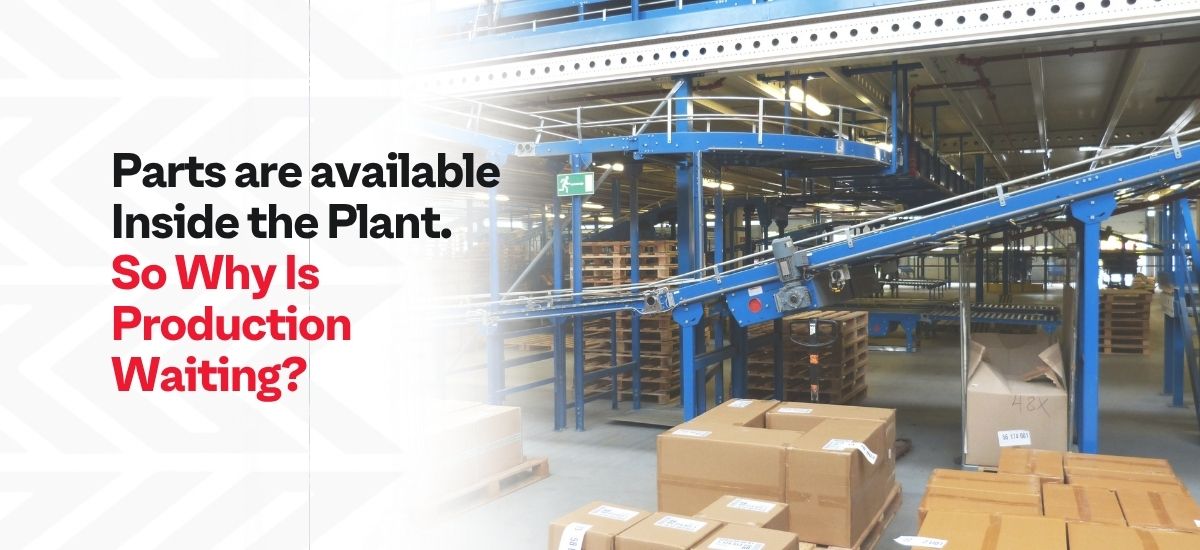
Parts are received in Plant. So Why Is Production Waiting?
The production line is ready. Operators are at their stations. The day’s schedule has started. Then a required component does not reach the line.
The warehouse team checks the stock. The part was received, inspected and stored. Even the warehouse management system shows it as available. Still, production is waiting.
The problem is not inventory shortage. It is the gap between material availability and actual material flow because “available is not the same as accessible”.
Stock Availability Does Not Guarantee Material Flow
Material inside the warehouse creates value only when production can use it.
This challenge appears across automotive plants, glass manufacturing units, OEM facilities and semiconductor operations. The material may be different. The operational risk remains the same.
If one component does not reach the right production point on time, the planned flow begins to slow down.
Stock may be available, but production needs accessibility.
Where In-Plant Logistics Management Breaks Down
Receiving, inspection, storage and line supply may all be working. But they are often managed as separate activities.
Material gets stored at an inconvenient location. Retrieval takes longer. Production priorities change, but the line supply plan is not updated. Teams start responding to urgent requests instead of following the production sequence.
This disconnect eventually reaches the shop floor.
Every gap between warehouse and production becomes waiting at the line.
Production Logistics Needs More Than Movement
Adding more forklifts or increasing movement may make the plant look busy. It does not necessarily improve production logistics. Effective in-plant logistics connects material receipt, inspection, storage, sequencing and line supply with the production plan.
It ensures that material is not only moved, but moved with a clear purpose. The right material must reach the right point when production requires it.
This is what well-planned shop floor logistics should achieve.
Movement is an activity. Production continuity is the outcome.
Build Material Flow Around Production
Good material flow systems in manufacturing begin with one question: what does production need next?
Storage locations, retrieval plans, staging, sequencing and line supply should work around that requirement. A warehouse management system in logistics can provide visibility. But people, processes and execution must convert that visibility into action.
KGC manages in-plant logistics around actual production requirements. By connecting warehouse operations with the shop floor, KGC helps create a smoother and more controlled material flow.
Because material inside the plant creates value only when production receives it on time.
Move beyond material movement. Build smoother plant operations with KGC.